What's Todd reading? Here are his TOP 6 picks for this week
"The Bible Is the Best Book in the World": 2nd President John Adams on Faith and Freedom in America
"The Bible Is the Best Book in the World": 2nd President John Adams on Faith and Freedom in America
"The Bible Is the Best Book in the World": 2nd President John Adams on Faith and Freedom in America
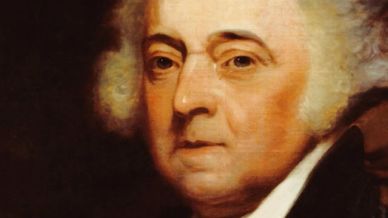
Revisionists want to wipe out or ignore evidence of America's Judeo-Christian heritage. But on this 250th anniversary of American independence, the evidence remains as clear as ever that Christianity was a core belief of this country's founders.
One example is found in John Adams, who is remembered for being one of the great minds and statesmen of the American Revolution. He was highly influential in America's earliest moments and went on to become the second president of the United States.
In June of 1776, John Adams was in Philadelphia, deep in the flurry of the push for freedom. The Continental Congress appointed him, along with Thomas Jefferson and three others, to draft a "Declaration of Independence" from England. His prolific diaries, letters, and books provide an invaluable insight into the thinking of the time and to what liberty meant to the founding fathers.....
The Virginia Declaration of Rights at 250
"The Bible Is the Best Book in the World": 2nd President John Adams on Faith and Freedom in America
"The Bible Is the Best Book in the World": 2nd President John Adams on Faith and Freedom in America
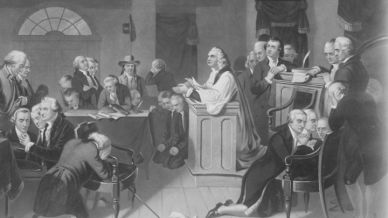
On June 12, 1776, Virginia’s Fifth Revolutionary Convention unanimously passed the Virginia Declaration of Rights. A trenchant, post-colonial statement affirming humankind’s inherent rights, limited government, and republican principles, the Declaration is arguably the nation’s most imitated founding document and a pillar of American founding principles. George Mason, the Declaration’s principal draftsman, boasted that it was the first of its kind on the American continent. It distilled the great principles of liberty and constitutionalism that revolutionary Americans believed were derived from England’s ancient constitution, common law, and natural rights theory.
Though overshadowed by the US Declaration of Independence, the Virginia Declaration was remarkably influential. In addition to directly informing bills of rights....
The Founders' Go-To Text: The Bible
"The Bible Is the Best Book in the World": 2nd President John Adams on Faith and Freedom in America
ZOOMABLE Original (Engrossed) Copy of The Declaration Of Independence

In his illuminating Reading the Bible with the Founding Fathers, Daniel L. Dreisbach shows how early Americans used the Bible both as an intellectual sourcebook and as a tool for moral instruction. He thinks “the Bible was the most authoritative, accessible, and familiar book in eighteenth-century America.” But be comforted, O Unbeliever! This book is not a work of Christian apologetics.
“A claim of biblical influence,” Dreisbach writes, “does not suggest that the founders were theocrats intent on imposing a biblical order on the polity.” On the contrary, he says, “Believers and skeptics alike made use of the Bible.” The American University professor is admirably cautious, avoiding the Scylla of making every Founder a deist and the Charybdis of making every reference to the Bible a mark of true Christian piety.
Nevertheless, Dreisbach has an agenda. He exhorts students of the Founding “to be attentive to how the founders read the Bible and its place in the political culture of the founding era.” His advice is....
ZOOMABLE Original (Engrossed) Copy of The Declaration Of Independence
ZOOMABLE Original (Engrossed) Copy of The Declaration Of Independence
ZOOMABLE Original (Engrossed) Copy of The Declaration Of Independence

- Engrossed Declaration of Independence.
Summary
- On July 4, 1776, the Second Continental Congress adopted the Declaration of Independence, in which the American colonies set forth a list of grievances against the British Crown and declared that they were breaking from British rule to form free and independent states. On July 19, 1776, Congress resolved that the Declaration passed on the 4th be "fairly engrossed on parchment with the title and stile [sic]: 'The unanimous declaration of the thirteen United States of America'...and that the same, when engrossed, be signed by every member of Congress." The engrossing was most likely done by Timothy Matlack, an assistant to Charles Thomson, Secretary of the Congress. Although it bears the date "July 4, 1776," the engrossed Declaration was signed on August 2, 1776, by members of the Continental Congress who were present that day and later, by other members of Congress. A total of 56 delegates eventually signed the document.
Preaching the Insurrection
ZOOMABLE Original (Engrossed) Copy of The Declaration Of Independence
Preaching the Insurrection
By Harry S. Stout, Ph.D., is a professor emeritus of American religious history at Yale University and a major scholar of preaching in early America.
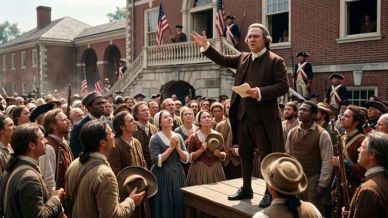
IT IS 1775. The year 1787, with its novel constitution and separation of church and state is a long 12 years away. At the moment, you and your friends are just a bunch of outlaws.
Youve heard the debates in Parliament over taxation and representation; youve seen British troops enforce royal supremacy at the point of a bayonet. Your king, George III, and Parliament have issued a declaration asserting their sovereignty in all cases whatsoever in the colonies. You are, at least in New England, a people under siege with British troops quartered in Boston. Youve dumped tea into Bostons harbor in a fit of rage and had your port closed.
Who will you turn to now for direction? There are no presidents or vice-presidents, no supreme court justices or public defenders to call on. There are a handful of young, radical lawyers, like the Adams cousins, John and Samuel, but theyre largely concentrated in cities, while you and most of your friends live in the country. In many colonies, including Massachusetts, there are not even elected governors or councilors—they have all been appointed by the British crown and are answerable to it.
Where you turn is where you have habitually turned for over a century: to the prophets of your society, your ministers....
Jesus vs. the Watchmaker
ZOOMABLE Original (Engrossed) Copy of The Declaration Of Independence
Preaching the Insurrection

By Dr. Derek H. Davis is director of the J.M. Dawson Institute of Church-State Studies from 1995 to 2006 at Baylor University in Waco, Texas. He wrote the Oxford University Press book:
Religion and the Continental Congress, 1774–1789: Contributions to Original Intent
Oxford University Press, 2000.
SOME ARGUE that the American Revolution was motivated by Christian ideals—the love of political and religious liberty, and the passion to create a society built on biblical values. Many scholars say the Revolution was merely the product of Enlightenment deists—rationalists who believed God, like a watchmaker, set the universe running and let people manage it by reason. They wanted to found a just and free society on rational, scientific principles.
How we resolve this disagreement depends upon how we pose the question. If the question is, Was there unambiguous biblical justification for the Revolution? we probably have to say no. While many Christians supported independence, many others (Tories) argued for submission to Great Britain—and many pacifists argued biblically that war under any circumstances was wrong.
If we ask instead whether the Revolution was sustained by Christian ideals (versus Enlightenment rationalism) the answer is tangled. In fact, both of these ideologies embraced the ideals and rhetoric of liberty and together were the driving forces behind the Revolution. Despite their pronounced differences, each supported the other and, in the words of historian Patricia Bonomi, “did not cause separate channels but flowed as one stream toward the crisis of 1776.”....


CrossFireUSA Inc.
Online Donations & Support
Help us grow and accomplish our mission. With your financial gift and support, we will continue to help others through 12 important actions, which you can read about HERE.
Our Partners






Faith Powered by Facts! Headlines Driven by Truth!
Discover the evidence behind your beliefs, America's spiritual roots, and the Top 50 faith news stories of the week, scientific proofs for God & the Bible, top scholarly videos, comparative religion studies, deep dive apologetics, and MUCH MORE! Subscribe FREE to our once-weekly "CrossFire Courier" Newsletter and "Tactical Tuesday" Insider Briefing! Delivered once a week to your inbox on Tuesdays & Saturday mornings. ALL for FREE! Subscribe now below (We respect your privacy, hate spam too, and will NEVER give out your email or name to anyone!)